
HOA Irrigation Repair & Maintenance in Orange County
Irrigation is the system your association owns the most of and sees the least of — miles of pipe, hundreds of heads, and a water bill that reports every failure a month late. We repair it fast when it breaks and maintain it so it mostly doesn't.
The system that spends your money quietly
A broken sprinkler head announces itself. Almost nothing else in an association's irrigation system does. A weeping valve adds hundreds to the water bill before anyone connects the number to a cause; a misprogrammed controller waters a greenbelt at 2 p.m. on a Tuesday for a whole season; a cracked lateral under a slope's ground cover shows up as a dying hillside six weeks after the failure. Irrigation is where HOA maintenance budgets leak first — literally — and it's the part of the property no board member can inspect from the sidewalk.
Greenhouse handles HOA irrigation repair across all of Orange County: leak response when water is actively moving, scheduled maintenance that catches failures while they're still cheap, and the documentation layer — photos, per-zone repair records, water-use trends — that lets a board actually govern the system instead of just paying for it. Licensed (CSLB #1136097), insured, and based in Santa Ana with routes county-wide.
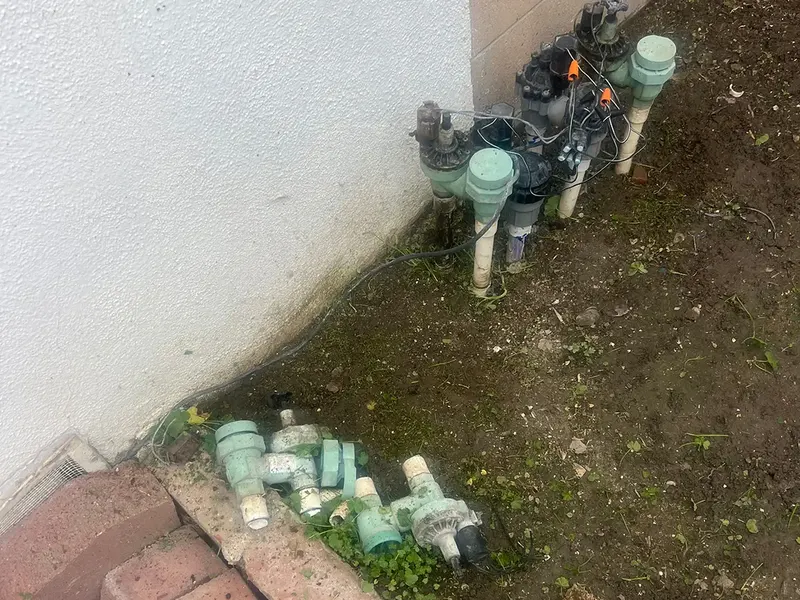
When water is moving: emergency response
Our HOA emergency irrigation service exists for the calls that can't wait for a board meeting: a mainline break flooding a street, a stuck valve running a zone around the clock, water undermining a slope or pouring across a sidewalk toward someone's garage. Call (714) 415-2315 and the first thing we do is help whoever's standing there stop the water — most systems can be isolated in minutes if someone knows where to look, and we'll direct you to the shutoff over the phone before a truck ever moves.
It's worth saying plainly: half the board members and managers who call us found the number by typing "HOA irrigation repair near me" into a phone while standing in running water. That's a fine way to find an emergency vendor and a bad way to run an irrigation system. The rest of this page is about the second part.
Not sure it's an "irrigation" problem? That's normal.
Managers rarely call and say "irrigation." They say the community has a water system problem — a leak somewhere, soggy ground that never dries, a zone that's dead while the one next to it won't shut off, a broken water line bubbling up through a greenbelt. If that's how you'd describe it, you're in the right place: on an HOA property, the "water system" outside the buildings is the irrigation system, and a sprinkler system problem, a mystery wet spot, and a spiking water bill are all the same phone call. Describe what you're seeing in your own words and we'll take it from there.
Scheduled maintenance: the program that pays for itself
Our HOA irrigation maintenance services run on a calendar, not on complaints. The core of the program is the monthly wet check — every zone run while a technician watches the heads, because broken coverage, pressure problems, and blocked spray are invisible on a controller screen and obvious in thirty seconds of moving water. Around that we layer seasonal controller reprogramming against your water district's current watering-day rules, valve and backflow inspection, and a standing repair log the board sees every month.
Irrigation maintenance for HOA common areas differs from residential work in one structural way: scale turns small percentages into real money. A single head watering the sidewalk wastes little; forty of them across a 200-door community, running unnoticed for a season on tiered water rates, is a line item. The program's job is to make sure nothing runs unnoticed — and the water bill, tracked month over month, is the scoreboard we expect boards to hold us to.
Slopes: where association systems actually fail
Most of Orange County's HOA slope acreage — Anaheim Hills, Yorba Linda, Aliso Viejo, Laguna Niguel, Mission Viejo, Rancho Santa Margarita — was planted for erosion control and irrigated to keep that planting alive, which makes slope irrigation a structural system wearing a landscaping costume. It's also where failures hide longest: nobody walks a slope, so nobody sees the geyser. We treat slopes as dedicated inspection zones, and we've published what boards should know about them — a slope irrigation repair cost guide and a plain-language explanation of why hillside systems fail the way they do. Slope turf is also the largest block of nonfunctional turf on most association properties, which makes it the first thing boards look at under AB 1572 — and a turf conversion is usually the moment to fix the pressure and runoff problems the slope has been living with.
What real irrigation management looks like
The difference between calling for repairs and hiring an HOA irrigation management company is the difference between owning problems one at a time and having someone own the system. HOA irrigation management means a named person is accountable for the whole loop: inspection schedule, repair log, controller programming, water-use trend, and the annual conversation with the board about what's aging toward the reserve study. When we propose an audit, upgrade, or smart controller project, it comes with the numbers that justify it — not "the system is old," but which valves failed, what they cost, and what the replacement earns back in water.
If your board is comparing vendors, vet us the way you'd vet any HOA irrigation maintenance contractor: verify CSLB #1136097 on the state lookup, ask for insurance certificates from the agent, and ask every bidder how repairs get documented and authorized. Most HOA sprinkler system repair work is honest; the variance is in what happens after the fix — whether anyone wrote down what failed, where, and why, so the board can see the pattern forming before it becomes a renovation.
One vendor for the whole common area, or just the water
Plenty of associations bring us in for irrigation alone alongside an existing landscaper, and that works — though it has a known failure mode we've written about honestly: split vendors pointing at each other when turf browns out. Irrigation is also built into our full HOA landscape maintenance program, where the crew that mows past a broken head is the same company that fixes it. Either way, when a leak is the immediate problem, start with the leak repair page and its board triage sequence or just call. If it can't wait for the next scheduled visit, we hold same-day slots for sprinkler repair today. For a single failing component, our mainline, valve, lateral line, and controller repair pages each cover diagnosis and our published rate for that part.
Water running right now?
Call (714) 415-2315 — we'll help you shut it off over the phone first, then get a technician moving.
Call or Text (714) 415-2315HOA irrigation FAQs
A mainline just broke and water is running down our street. How fast can you get here?
Call (714) 415-2315 and we will walk whoever is on site through shutting off the affected zone or the system master valve over the phone — that stops the damage immediately, whoever ends up doing the repair. From there we dispatch from Santa Ana and prioritize active-water emergencies over scheduled work. Flooding common areas, water crossing sidewalks, and saturated slopes go to the front of the line.
Do you work on a repair-call basis or only under maintenance contracts?
Both. Associations call us for one-off repairs constantly, and we take that work seriously — it is usually how a board first evaluates us. But irrigation on a multi-acre property genuinely needs a schedule: monthly wet checks, seasonal reprogramming, and someone accountable for the water bill trend. Most repair-call relationships become maintenance programs once the board sees the difference in the documentation.
Our common areas include slopes. Does that change the work?
Substantially. Slope irrigation fails more often and hides it better — pressure problems at the top of the slope, runoff and erosion at the bottom, and breaks concealed under ground cover. We treat association slopes as their own inspection zone with their own schedule, because a slope failure is never just a plant-replacement problem; left alone it becomes an erosion repair, and eventually a geotechnical one.
How do repairs get authorized? Our board only meets monthly.
We work inside your authorization structure, not around it. Typical setup: a pre-approved dollar threshold for routine repairs (so a $90 valve fix does not wait thirty days while a zone runs broken), written quotes with photos for anything above it, and emergency authority defined in advance for active-water situations. Every repair — routine or emergency — is documented with location, cause, parts, and cost, so the board packet writes itself.
Can you take over a system another company installed or maintained?
Yes, and it is most of what we do — associations rarely call an irrigation contractor when everything is working. We start takeovers with a full system walk: every controller inventoried and photographed, every zone run and watched, known problems listed with repair pricing. You get a written baseline of what we inherited, which protects the association and us equally.
Is the irrigation inspection free? How do you price the actual repair?
The inspection is free — we run every zone, check the controller and valves, and put the findings in writing at no charge, whether or not you hire us. Pricing the repair is a separate step, and an honest one: we cannot know the real complexity of a system problem until it is fully inspected. A stuck valve is a small fixed part; a hidden mainline break under a slope is not. So we inspect first, show you exactly what is failing and why, then quote the repair against what we actually found — never a guessed number over the phone.
Do you serve all of Orange County or just the Santa Ana area?
All of it. We are based in Santa Ana and run routes county-wide — from Yorba Linda and Anaheim Hills down through Irvine to Aliso Viejo, Laguna Niguel, Mission Viejo, and Rancho Santa Margarita, and out to the coast. The hillside south-county communities are actually where our slope work concentrates.
Tired of finding out about leaks from the water bill?
Ask for a free irrigation system inspection — every zone run and watched, findings in writing, whether or not you hire us.
Call or Text (714) 415-2315