
Commercial & HOA Artificial Turf Installation — Orange County & LA County
Synthetic turf is either a fifteen-year asset or a two-year regret, and the difference is almost entirely in the base, the drainage, and the honesty of whoever sold it. Greenhouse builds commercial artificial turf for association common areas, park and play surfaces, and commercial frontage across Orange County and Los Angeles County — and tells boards when they shouldn't buy it.
Why the math changed for common areas
Water districts across the county now run tiered pricing and enforce watering-day limits, and the landscape that suffers most is the turf nobody walks on: parkway strips between sidewalk and wall, entry medians, the slivers of lawn that exist to be looked at from a car. Those areas consume the most water per square foot of visual return and generate the most overspray complaints. Add the places living grass genuinely loses — pool surrounds, dog runs, shaded courtyards, common areas under constant foot traffic — and artificial grass in Orange County has moved onto reserve studies and capital plans as a line item boards can defend.
Our position differs from the turf-sales industry's, because we are a maintenance company first. We don't need to sell turf; we need the property to look right year-round, because our name stays on it after the install crew leaves. That is why our first answer is sometimes that a California-friendly planting conversion serves the site better — and unlike synthetic turf, that conversion is typically what water rebates actually fund. Where the driver is AB 1572 compliance rather than appearance, both paths satisfy the law — synthetic turf needs no irrigation at all — but only a planting conversion is generally rebate-eligible, and that gap is worth pricing before a board votes.
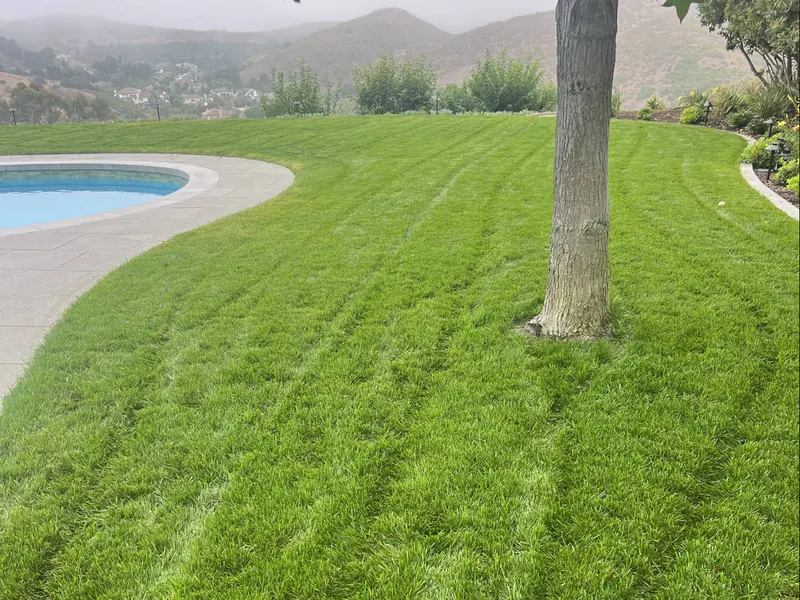
Where commercial turf earns its cost
HOA common areas
Medians, parkways, entry monuments, dog areas, and the narrow strips that overspray onto sidewalks every cycle. These are the highest-cost, lowest-benefit irrigated areas in most associations, and they are where conversions pay off first. For boards, the work is scoped the same way we scope HOA landscape maintenance: defined area, named product, drainage plan, flat price, presented at the meeting if you want us there.
Parks, play areas, and open turf
Artificial turf for parks in Orange County splits into two very different specifications. Open play and event lawn needs traffic-rated fiber and an infill that handles heat and compaction. Anything under play equipment is a safety system: a shock pad matched to the equipment fall height, turf tested as an assembly for impact attenuation, and a firm, stable surface along accessible routes. Quoting those two as one line is how facilities managers end up with a play surface that was never rated for play.
Commercial property frontage
Frontage is what tenants and prospective tenants judge a property by, and it is usually the strip most punished by street heat, foot traffic, and irrigation restrictions. Commercial turf installation in Orange County works well here because frontage is small, highly visible, and expensive to keep green by conventional means. We phase it around tenant access and business hours, the same way we schedule commercial landscape maintenance visits.
Pet areas and high-traffic zones
Dog runs and pet relief areas need permeable backing, antimicrobial or mineral infill rather than standard crumb, and a rinse plan — odor in a pet area is almost always a drainage and infill failure, not a turf failure. Traffic lanes near mail centers, pools, and clubhouse entries need higher face weight and denser stitching, or they flatten into shiny paths within a year.
The base is the job
The turf you see is the cheap part. Nearly every failed installation we are called to inspect failed underneath, and the failures are predictable.
Demo and irrigation rework
Existing turf comes out with its root layer, not just its top. Heads inside the conversion area get capped below grade or pulled, while the supply feeding surrounding trees and planters is preserved and tested — the second-most-common conversion mistake in Orange County is cutting water to a mature tree and discovering it in August. Having the same licensed crew handle the irrigation rework is how that gets avoided.
Base and compaction
Three to four inches of open-graded aggregate, placed and compacted in lifts, graded to drain. On the clay soils inland of the 55 and across the LA foothill communities, an under-built base is how a synthetic lawn becomes a synthetic pond every January. Our crews run their own plate compactors and demo equipment rather than renting, which is why a promised base depth is the base depth that gets built.
Drainage under the turf
Permeable backing only moves water to the layer below it. If that layer has nowhere to send it, the water sits, the infill sours, and the seams lift. A correct build grades the subgrade toward a discharge point and ties into area drains or a French drain where the site calls for it — the same drainage installation and repair work we do as a standalone service. On any site with a known ponding history, we scope drainage before we price turf, not after.
Slope-stable installs
On grades, seams run across the fall line, anchoring gets deeper and more frequent, and the base is built in compacted lifts so it cannot creep downhill. Slopes are also where turf solves the most expensive problem in the county: hillside irrigation that fails quietly and takes the ground cover, then the soil, with it. Where a slope is genuinely ornamental and constantly failing, turf ends the cycle.
What it costs, and the water payback
Artificial turf installation in Orange County generally lands between $12 and $20 per square foot for a properly built commercial job, and the spread is driven by access, base depth, drainage, slope, and the turf spec itself rather than by negotiation. The water savings are real but slower than sales pitches suggest: irrigated cool-season turf in Orange County consumes roughly 25 to 35 gallons per square foot per year, which at current retail rates is a meaningful but not dramatic number on its own. The case gets strong when you add the labor those areas consume — mowing, edging, string-trimming, reseeding, overspray complaints — which is exactly why turf pays back fastest on small, awkward, high-hassle areas and slowest on big open lawns.
We work the numbers by project type in what artificial turf costs for HOA common areas and commercial properties, and if you're sizing a whole maintenance budget rather than one conversion, the HOA cost calculator gives you neutral market ranges in about two minutes.
Maintenance expectations, stated up front
An artificial lawn in Orange County is low-maintenance, not no-maintenance, and vendors who say otherwise are setting up the complaint you'll file in year three. Fibers need periodic power brushing to stand back up. Leaf litter has to come off before it composts into the infill and turns a permeable surface into a sealed one. Traffic lanes need infill top-ups. Pet zones need rinsing on a schedule. None of it is difficult, and on properties where we already run HOA maintenance it simply joins the visit checklist — which is the difference between turf reaching its rated life and turf aging out early.
Straight answers before you spend
Three things we say on the first call that turf salesmen tend to skip. Synthetic turf runs far hotter than grass on summer afternoons, so south- and west-facing areas where residents actually sit deserve a hard think. Rebate programs in this region have generally funded living conversions rather than synthetic, so if the rebate is load-bearing in your budget, the answer may change. And under mature trees, turf is usually wrong for both the tree and the turf. We would rather lose the install than have a board point at a failed one with our name on it.
We are licensed and insured commercial turf installers in Orange County and Los Angeles County — CSLB #1136097, employed crews, owned equipment, and the owner walks every project before it's quoted and after it's built. Call (714) 415-2315 for a site walk and a written quote naming the turf spec, base depth, and drainage plan. If the better answer for your property is planting or decomposed granite, you'll hear that instead.
Get a turf quote you can actually compare.
Product named, base depth specified, drainage planned, flat price. Call (714) 415-2315 and we'll walk the site.
Call or Text (714) 415-2315Commercial & HOA artificial turf FAQs
How much does commercial artificial turf installation cost in Orange County?
For a properly built commercial installation — full demo, compacted base, drainage, commercial-grade turf, and infill — expect roughly $12 to $20 per square foot in Orange County. Large open common areas price at the low end; small strips, hard-access courtyards, playground systems with certified fall-height padding, and slope work sit at the top. Quotes well below that range usually mean thin base prep or bargain turf, and both surface as wrinkles, seam separation, odors, or standing water within a couple of years. We break the numbers down by project type in our artificial turf cost guide, and we quote in writing after measuring the actual site, with the turf spec named.
Can artificial turf be installed on slopes?
Yes, and it is one of the places synthetic turf genuinely outperforms grass — no mowing on a grade, no irrigation overspray saturating a hillside, no bare patches feeding erosion. The engineering is different, though. Slope installs need deeper anchoring, seams run across the fall line rather than down it, the base has to be compacted in lifts so it does not creep, and subsurface drainage has to be designed for water moving through the slope rather than just under the turf. Installed without that, turf on a grade wrinkles at the toe and lifts at the crown within two seasons.
What happens to drainage underneath artificial turf?
Water still has to go somewhere, and this is where most failed installations fail. Turf backing is permeable, so rain and rinse water pass through and land on the base — which on Orange County clay means a compacted layer sitting on soil that drains slowly. A proper build grades the subgrade to a discharge point, uses open-graded aggregate that moves water laterally, and ties into area drains or a French drain where the site needs it. We handle that work ourselves rather than subbing it, which is why turf and drainage get scoped together on our projects.
Is artificial turf suitable for parks and playgrounds?
For playgrounds it is a specific product category, not general landscape turf. Play areas under equipment need a shock pad sized to the equipment fall height and turf that has been tested as a system to the impact-attenuation standard, plus a firm, stable, slip-resistant surface for accessible routes. Park and open-play turf is a different spec again — longer pile, traffic-rated fiber, and infill chosen for heat and heavy use. We spec these separately in writing so a board or facilities manager can see exactly which system is being priced.
How long does commercial turf last, and what maintenance does it need?
Quality commercial turf over proper base prep runs about 15 years, with high-traffic lanes, dog areas, and full-sun south exposures aging faster. It is not zero-maintenance. It needs periodic power brushing to keep fibers upright, debris blowing before organic matter composts into the infill, infill top-ups in traffic lanes, and rinsing in pet areas. Left alone, turf mats down and drains poorly, and the 15-year product becomes an 8-year product. On properties we already maintain, this folds into the regular visit schedule.
Where does artificial turf not belong?
Under mature trees, where root heave breaks up the base and the surface temperature and lost soil permeability stress the tree. On south- and west-facing gathering areas, because synthetic turf runs dramatically hotter than grass on summer afternoons — surface temperatures well above ambient are normal, and that matters where people and pets sit. And anywhere a low-water planting conversion would look better and cost less, which is more sites than the turf industry admits. Those conversions are also what regional rebate programs have generally funded, while synthetic turf typically has not qualified.
Do rebates cover artificial grass in Orange County?
Usually not. The main regional turf-replacement rebate program — SoCal WaterSmart, administered locally through MWDOC — has generally required conversion to living, California-friendly plantings with efficient irrigation, and synthetic turf typically has not qualified, though individual cities and districts have run their own programs with different rules at different times. Treat any contractor who implies a guaranteed rebate on synthetic turf as a warning sign. We will tell you what your specific district currently offers before you commit.
Fifteen-year turf starts with the first four inches.
Artificial grass installation in Orange County & LA County for HOA common areas, parks, and commercial frontage. Call (714) 415-2315.
Call or Text (714) 415-2315